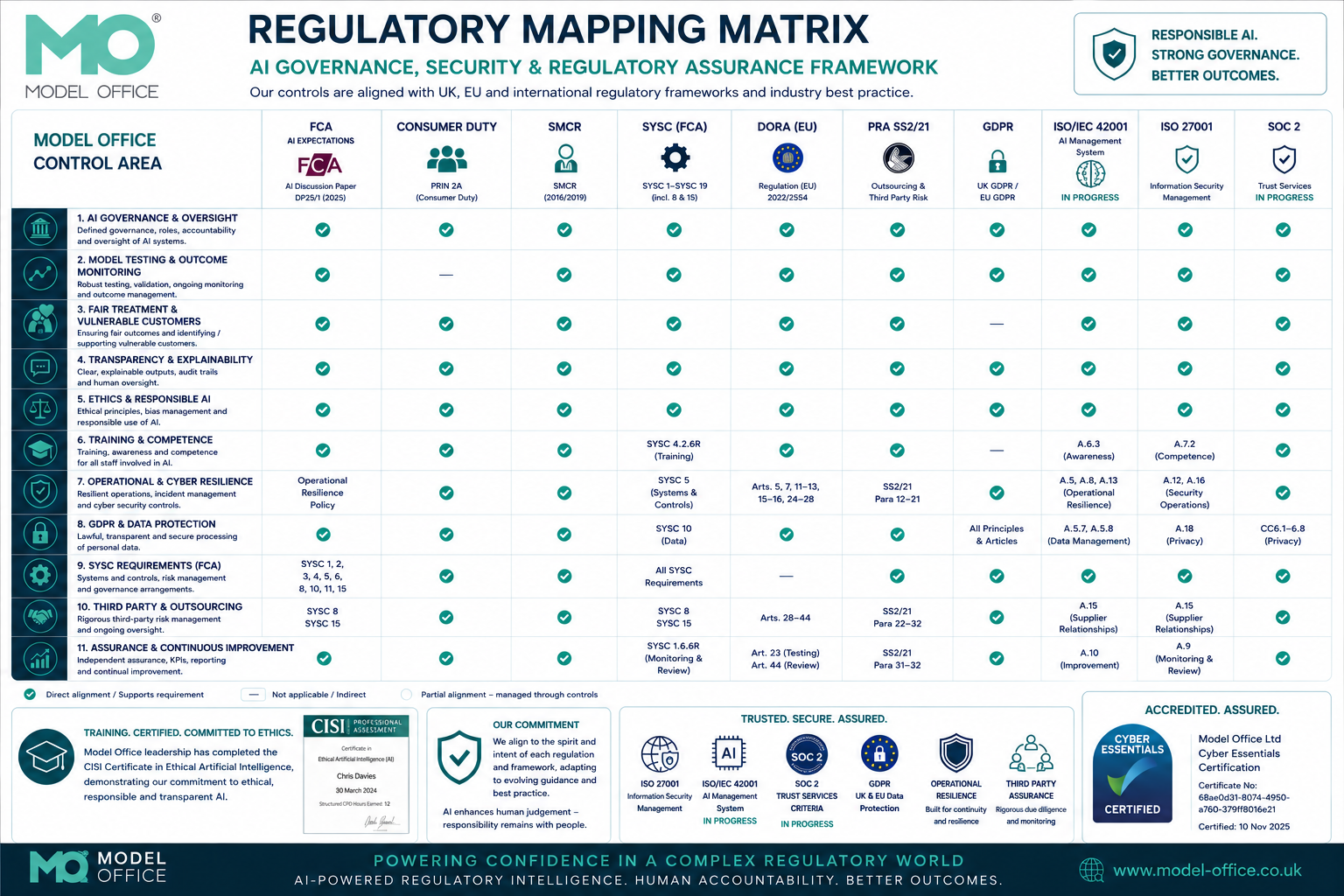
AI Governance, Security & Regulatory Assurance Framework
Responsible AI for Financial Services
Model Office provides AI-powered Regulatory Intelligence, Governance, Risk and Compliance technology designed specifically for FCA regulated financial advisers, wealth managers, mortgage firms, protection firms, appointed representative networks and consolidators.
Our approach to Artificial Intelligence is founded on regulatory accountability, operational resilience, transparency, consumer protection and ethical deployment.
AI is used to enhance governance and oversight, not replace human judgement or regulatory responsibility.
Governance & Accountability
Senior Management Accountability
Model Office operates clear governance arrangements aligned to:
- Senior Managers & Certification Regime (SMCR)
- FCA SYSC
- Consumer Duty
- PRA expectations
- DORA governance requirements
Every AI capability has:
- Defined ownership
- Documented governance
- Risk assessment
- Change management controls
- Escalation procedures
- Ongoing monitoring
Ultimate responsibility for decisions remains with appropriately authorised individuals and regulated firms.
FCA AI Governance Controls
Model Office has implemented governance controls aligned with emerging FCA expectations regarding AI deployment within financial services.
1. Oversight and Governance of AI
We maintain:
AI Governance Framework
- AI governance committee oversight
- Defined accountability structures
- Documented AI inventory
- Risk classification methodology
- Material model review process
- Third-party AI governance assessments
Policy Controls
- Responsible AI Policy
- Information Security Policy
- Data Protection Policy
- Operational Resilience Framework
- Model Risk Management Framework
- Vendor Management Framework
Board and Management Reporting
Regular reporting includes:
- Model performance
- Risk indicators
- Incident reporting
- Consumer outcome metrics
- Data quality monitoring
- Vulnerability assessments
2. Model Testing and Outcome Monitoring
All material AI models are subject to lifecycle controls.
Pre-Deployment Testing
Models undergo:
- Functional testing
- Accuracy validation
- Performance benchmarking
- Security assessment
- Data quality validation
- Hallucination testing
- Bias assessment
Ongoing Monitoring
Model Office continuously monitors:
- Model drift
- Data drift
- Accuracy levels
- Exception rates
- User feedback
- False positive rates
- False negative rates
Continuous Improvement
Monitoring results feed into:
- Model retraining decisions
- Rule refinement
- Risk reviews
- Governance reporting
Material changes are subject to formal approval procedures.
3. Fair Treatment of Customers
Consumer outcomes remain central to Model Office's AI governance approach.
Our controls align with:
- FCA Consumer Duty
- FCA Vulnerable Customer Guidance
- Equality and fairness principles
- Ethical AI standards
Fairness Controls
We assess models for:
- Discriminatory outcomes
- Bias indicators
- Data quality issues
- Inconsistent treatment
- Unintended consequences
Vulnerable Customer Oversight
AI systems are designed to support identification and oversight of:
- Bereavement
- Financial difficulty
- Health-related vulnerabilities
- Cognitive vulnerabilities
- Life events
- Characteristics of vulnerability
Models are reviewed to ensure vulnerable customers are not disadvantaged by automated processes or AI-generated outputs.
Consumer Duty Outcomes
AI systems support monitoring across:
- Products and Services
- Price and Value
- Consumer Understanding
- Consumer Support
This assists firms in evidencing good outcomes and identifying emerging risks earlier.
4. Explainability and Transparency
Model Office recognises that firms must understand how AI-generated outputs are produced.
Our approach includes:
Explainable Outputs
Users can understand:
- Why an alert was generated
- Which data sources were used
- Which controls were assessed
- What evidence supported findings
Auditability
Model Office maintains:
- Full audit trails
- Time-stamped activities
- User attribution
- Evidence repositories
- Change histories
Human Review
AI-generated findings are designed to assist decision-making and remain subject to human review and challenge.
No regulatory responsibility is delegated to AI systems.
Ethical AI Framework
Model Office applies the following ethical principles:
Fairness
AI should support consistent and fair outcomes.
Accountability
Humans remain accountable for decisions.
Transparency
Outputs should be explainable and traceable.
Privacy
Personal data must be protected and processed lawfully.
Security
AI systems must operate within secure environments.
Reliability
Models must be monitored and maintained.
Consumer Protection
AI should support good customer outcomes.
Regulatory Integrity
AI should strengthen governance, oversight and compliance capability.
AI Competence & Professional Standards
Model Office believes AI governance requires both technical capability and ethical understanding.
Leadership has undertaken formal ethical AI training through the Chartered Institute for Securities & Investment (CISI), including achievement of the CISI Certificate in Ethical Artificial Intelligence.
This commitment supports:
- Responsible AI deployment
- Ethical decision making
- Consumer protection
- Regulatory compliance
- Governance best practice
Security & Cyber Assurance
Model Office maintains controls aligned to: ISO 27001 Principles
Including:
- Access management
- Asset management
- Risk management
- Incident management
- Supplier controls
- Business continuity
SOC 2 Trust Service Criteria
Supporting:
- Security
- Availability
- Processing integrity
- Confidentiality
- Privacy
Cyber Security Controls
- Encryption in transit and at rest
- Multi-factor authentication
- Secure software development
- Vulnerability management
- Security monitoring
- Penetration testing
- Incident response procedures
Regulatory Alignment
FCA
- SMCR
- SYSC 8
- SYSC 15
- Consumer Duty
- Operational Resilience Framework
- Vulnerable Customer Guidance
PRA
- PRA SS2/21
- Outsourcing and Third-Party Risk Management
EU
- DORA
- EBA Outsourcing Guidelines
- GDPR
AI & Model Risk
- SR 11-7 Model Risk Management
- Model Risk Management Principles
- Emerging UK AI Governance Expectations
Security
- ISO 27001 Principles
- ISO 42001 managing and implementing Artificial Intelligence systems responsibly (in progress)
- Cyber Essentials
- SOC 2 Trust Services Criteria (in progress)
Third-Party & Vendor Risk Management
Model Office operates a risk-based vendor assurance programme covering:
- Supplier due diligence
- Information security reviews
- Data protection assessments
- Operational resilience reviews
- Business continuity arrangements
- Sub-contractor oversight
- Incident management capability
This framework supports compliance with:
- FCA SYSC 8
- FCA SYSC 15
- GDPR/DORA
- PRA SS2/21
- ICT Third-Party Risk Management requirements
Operational Resilience
Model Office maintains operational resilience arrangements designed to support the continuity of critical services.
Controls include:
- Business continuity planning
- Disaster recovery procedures
- Incident management processes
- Supplier resilience reviews
- Service monitoring
- Recovery testing
These controls are aligned to FCA, PRA and DORA resilience expectations.
Continuous Assurance
AI governance is not a one-off exercise.
Model Office continuously reviews:
- Regulatory developments
- FCA guidance
- Consumer Duty requirements
- Security threats
- AI risks
- Operational resilience expectations
Our objective is simple: To provide regulated firms with AI-powered regulatory intelligence while maintaining the highest standards of governance, accountability, security, resilience and consumer protection.